TopHeat Review: Cheap Warmth Right Where You’re Cold?
Cold feet under the desk? A bathroom that bites at 6 a.m.? Here’s who TopHeat really works for, what it costs to run, and how to buy it without regrets.
Official product photos
From the official seller site · tap a photo to enlarge
Quick verdict
30-second readBest for: warming the one spot you’re sitting in — a desk, a reading chair, a small bathroom — with zero installation and pennies-per-hour running cost.
A grab-and-plug personal warmer. Buy it to stop being cold where you are, not to heat a whole house.
Affiliate link · we may earn a commission · details
Disclosure: some links on this page are affiliate links. If you buy through them we may earn a commission at no extra cost to you. It never changes the verdict. Details
What this is based on: the seller’s listings as described by independent review sites, public buyer reviews and complaint pages, NFPA/USFA safety guidance, DOE energy guidance and EIA electricity prices. We haven’t bought or measured a TopHeat yet — anything the seller says is labeled as a seller claim.
On this page
You know the feeling. The thermostat says 68°F, but your feet are ice under the desk. Your fingers go stiff on the keyboard. The bathroom tiles at 6 a.m. feel like a punishment. And every time you think about turning the heat up, you picture the next bill.
Here’s the thing most people miss: you don’t need to heat the whole house to stop being cold. You need to heat you. That’s exactly the job TopHeat is built for — and when you use it for that job, it makes a lot of sense.
The real problem: you’re paying to heat rooms you’re not in
Central heating warms every room, hallway and empty guest bedroom to get the one chair you’re sitting in comfortable. That’s why “just turn it up two degrees” gets expensive fast.
A small personal heater flips the math. Keep the house a little cooler, and put the warmth where your body actually is. The U.S. Department of Energy says turning your thermostat back 7–10°F for 8 hours a day can save as much as 10% a year on heating and cooling. A personal heater is what makes that setback comfortable in the room you’re using.

What TopHeat is (in plain English)
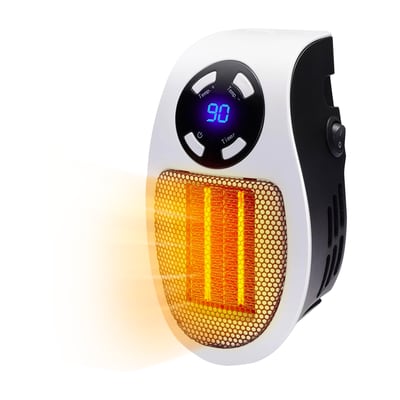
TopHeat is a compact ceramic fan heater that plugs straight into a wall outlet. A ceramic element warms up and a small fan pushes the warm air out toward you — the same proven technology as most compact space heaters, packed into a body that hangs on the outlet instead of sitting on the floor. Seller listings also mention overheat protection and tip-over shutoff (seller claims — check the box when it arrives).
Why people buy it
- Warm air in moments, not an hour. Ceramic fan heaters start blowing warm air almost as soon as you switch them on. No waiting for a furnace cycle to reach your corner.
- Zero installation. No tools, no mounting, no cord snaking across the floor to trip over. Plug it in, switch it on.
- Goes where you go. Desk in the morning, bathroom before a shower, reading chair at night — any standard outlet.
- Pennies per hour. At the reported 350–500 W, it costs roughly 6–9 cents an hour at the U.S. average electricity price (math below).
- No fumes. It’s electric: no flame, no fuel smell, no carbon monoxide.
- A gift people actually use. Know someone who wears a blanket at their desk all winter? This is a practical, low-cost present.
Opens the official seller site · affiliate link
What it really costs to run (by state)
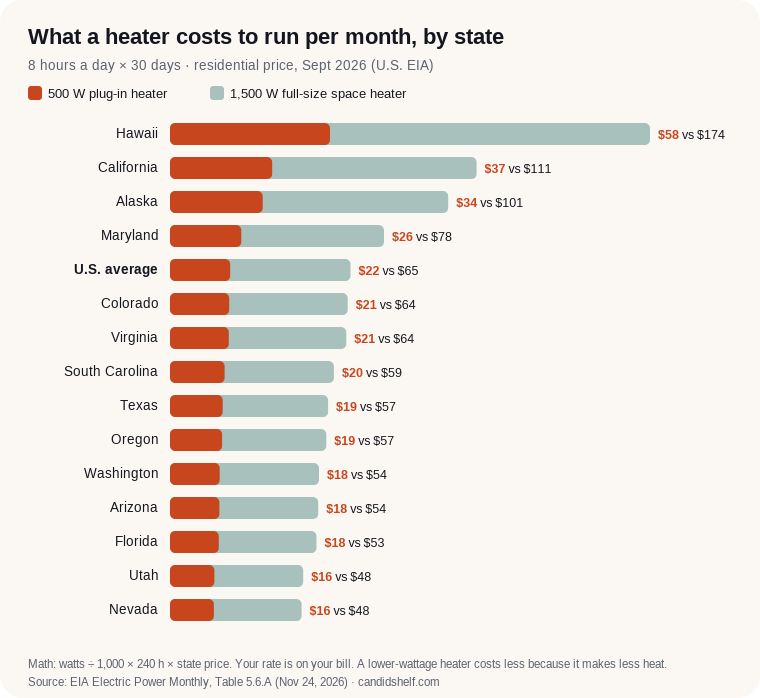
Low wattage is the secret to the low bill. Here’s TopHeat at the two wattages reported by independent sources, using the U.S. average residential price of 18.17¢/kWh (EIA, September 2026):
| If it draws… | Per hour | 4 h/day for a month | 8 h/day for a month |
|---|---|---|---|
| 350 W | ≈ $0.06 | ≈ $8 | ≈ $15 |
| 500 W | ≈ $0.09 | ≈ $11 | ≈ $22 |
Where you live changes everything. At 500 W, 4 hours a day for 30 days: Florida ≈ $9, Texas ≈ $10, U.S. average ≈ $11, California ≈ $19, Hawaii ≈ $29.
Plug in your own rate and hours:
Running-cost calculator
What will it cost you?
Electric heaters turn the power they draw into heat. Cost depends only on watts, hours and your rate.
Default rate: U.S. average residential price, 18.17¢/kWh (EIA, Sept 2026). Check your bill for yours.
Per hour
—
Per 30 days
—
Heat output
—
TopHeat vs the alternatives
| Feature | TopHeat (wall-plug) | Full-size 1,500 W heater | Turn up central heat |
|---|---|---|---|
| Setup | ✓ Plug into outlet Edge | Floor unit + cord | ✓ Nothing |
| Cost per hour | ≈ $0.06–$0.09 Edge | ≈ $0.27 | Whole-house — highest |
| Space it warms | Desk / small bathroom (~35–50 sq ft) | ✓ Small–medium room (~150 sq ft) | ✓ Every room |
| Floor space | ✓ None Edge | ✗ Takes floor space | ✓ None |
| Moves room to room | ✓ Any outlet | ✓ Carry it | ✗ No |
| Wattage published | ? Not clearly | ✓ Usually on the box | — |
| Best for | Warming YOU, cheaply | Warming a whole small room | Warming the whole house |
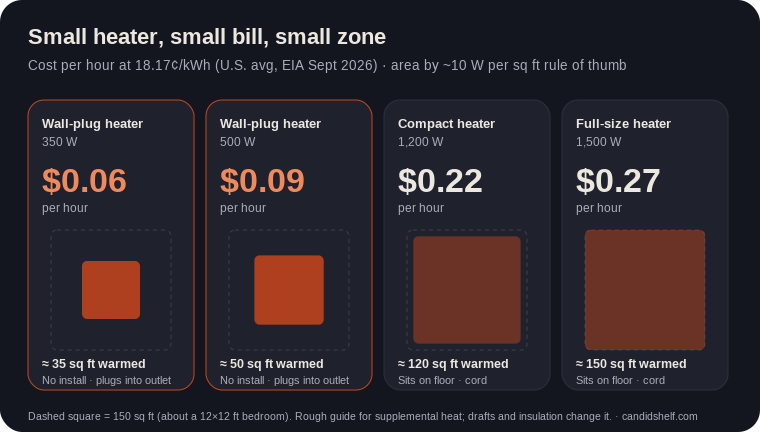
The bottom line: if your problem is “I’m cold right here,” TopHeat is the cheapest way to fix it per hour. If your problem is “this whole room is freezing,” a full-size heater is the better tool.
Opens the official seller site · affiliate link
Your doubts, answered
“Is TopHeat a scam?”
We found no sign it’s a no-delivery scam: buyers report receiving the heater. The complaints on independent sites (sources below) are about expectations and service, not missing parcels: heat that’s close-range rather than whole-room, fan noise, a lightweight plastic build, and slow refunds — 99consumer shows 2.0/5 from 13 reviews for the seller site, mostly about service. Reviewopedia also notes very similar heaters sold under other names — HeatSpace, for one, is sold on the same advertiser site with identical product photos (see our HeatSpace review, which has a 90-day guarantee on its checkout). Our advice: buy it for spot heating, pay by card or PayPal, and keep your order email.
“Will it actually keep me warm?”
Right next to you — that’s what it’s for. Rule of thumb: about 10 W per square foot of supplemental heat, so a 350–500 W unit covers roughly a desk zone or a small bathroom. Sit within a few feet of it and you’ll feel the difference; expect it to heat a big living room and you’ll be disappointed.
“Is it safe?”
Electric ceramic heaters don’t burn fuel, so there’s no carbon monoxide. Like every portable heater, use it the way NFPA and the U.S. Fire Administration recommend: plug it straight into a wall outlet (never a power strip), keep 3 feet clear of curtains, bedding and furniture, and switch it off when you leave the room or go to sleep. Unplug it if the plug feels hot or you smell burning.
“Is it noisy?”
It has a fan, and some buyers say the hum bothered them at night. For a desk or a bathroom, most people won’t care; if you need silence, a fanless option is a better fit.
“What if it’s not for me?”
Read the return terms at checkout before you pay — the window, who pays return shipping, any restocking fee — and keep the packaging until you’re happy. That’s a two-minute check that removes the risk.
Opens the official seller site · affiliate link
Winter moves fast — don’t wait for the cold snap
Cold snaps arrive with little warning, and nearly half of U.S. home heating fires — a good proxy for when people lean on heaters — happen between December and February (NFPA). If you want warmth before the next freeze, or you’re buying a gift for the holidays, order early and check the delivery estimate at checkout; we can’t confirm the seller’s shipping times.
Who should skip it
- You need to heat a large room → get a full-size heater with a stated 1,500 W rating and a UL/ETL mark.
- You want heat while you sleep → no portable heater should run unattended.
- You won’t buy without a published wattage → ask the seller first.
Our verdict
If you’re tired of being cold in one spot and don’t want to pay to heat the whole house, TopHeat is a simple, cheap-to-run fix: plug it in, feel warm air where you sit, and turn the thermostat down a notch. Use it for what it is — a personal warmer — and it’s easy to like.
Opens the official seller site · affiliate link
For more on costs and safety, read are plug-in wall heaters worth it?
Questions people ask
Does the TopHeat heater really work?
Yes — for the right job. It’s a small ceramic fan heater, so it blows warm air you feel close to the unit. It’s a personal, close-range warmer for a desk, chair or small bathroom. It won’t replace your furnace for a whole room.
How many watts is TopHeat?
The seller doesn’t clearly publish it. One review site lists 500 W; Reviewopedia says similar unbranded units are 350 W. Check the rating label on the unit when it arrives. Either way, running cost is low: roughly 6–9 cents an hour at the U.S. average price.
Is TopHeat a scam?
We found no evidence it’s a no-delivery scam — buyers report receiving the product. The complaints are about expectations (heat that’s close-range rather than whole-room), fan noise, build quality and slow refunds. Buy it for spot heating, pay by card or PayPal, and save your order email.
Will TopHeat lower my electric bill?
Not on its own — every electric heater turns power into heat at about the same efficiency. It can help you save if you use it to stay comfortable while turning the main thermostat down. The U.S. Department of Energy says turning your thermostat back 7–10°F for 8 hours a day can save as much as 10% a year on heating and cooling.
Can I leave TopHeat on overnight?
No. NFPA and the U.S. Fire Administration say to turn portable heaters off when you go to sleep or leave the room. Use it while you’re there, switch it off when you go.
Is TopHeat a good gift?
It’s a practical one for someone who’s always cold at their desk or in a chilly bathroom. Check the seller’s delivery estimate at checkout if you need it by a certain date — we can’t confirm shipping times.
What if I don’t like it?
Read the return policy at checkout before you pay: how many days, who pays return shipping and whether there’s a restocking fee. Keep the box and packaging until you’re sure.
Sources
- [1]Reviewopedia — Top Heat reviews: legit or scam? (wattage, rebrands)
- [2]The Buyers Reviews — Top Heat reviews (listed specs)
- [3]Infoquu — TopHeat buyer experience
- [4]Ibisik — TopHeat buyer experience
- [5]99consumer — Buy-Topheat.com customer reviews
- [6]NFPA — Portable electric space heater safety
- [7]NFPA — U.S. home heating fires peak during winter months (Jan 2026)
- [8]U.S. Fire Administration — Heating fire safety
- [9]U.S. EIA — Electric Power Monthly, Table 5.6.A (residential price by state, Sept 2026)
- [10]U.S. Department of Energy — Programmable thermostats (setback savings)
- [11]U.S. Department of Energy — Electric resistance heating
Hatim Founder & editor
Hatim founded CandidShelf and writes its reviews. He reads the seller pages, the fine print and the complaint records, runs the cost math with U.S. government data, and says plainly when something hasn’t been hands-on tested yet.