Is HeatSpace Worth It? Yes — If You Need Spot Heat
Tile floors that bite at 6 a.m. A desk where your toes go numb. Here’s who HeatSpace really works for, what it costs to run, and the fine print to read before you order.
Official product photos
From the official seller site · tap a photo to enlarge
Quick verdict
30-second readBest for: warming one small spot — a chilly bathroom, a desk, a bedside while you’re awake — with nothing to install.
A plug-in personal heater with a thermostat, a timer and a 90-day guarantee. Buy it to warm the space you’re in, not the house.
Affiliate link · we may earn a commission · details
Disclosure: some links on this page are affiliate links. If you buy through them we may earn a commission at no extra cost to you. It never changes the verdict. Details
What this is based on: the official HeatSpace sales, checkout, returns and contact pages (checked 26 November 2026), independent scam-watch and review sites, NFPA/USFA safety guidance, DOE energy guidance and EIA electricity prices. We haven’t bought or measured a HeatSpace yet — anything the seller says is labeled as a seller claim.
On this page
- 01The real problem: you’re paying to heat empty rooms
- 02What HeatSpace is (in plain English)
- 03Why people buy it
- 04What it really costs to run
- 05HeatSpace vs the alternatives
- 06The fine print, decoded
- 07Your doubts, answered
- 08Winter is here — get warm before the next cold snap
- 09Who should skip it
- 10Our verdict
It’s 6 a.m. You step out of a warm bed onto bathroom tiles so cold they sting. Or it’s 3 p.m., the thermostat says 68°F, and your toes have gone numb under the desk while the rest of the house sits warm and empty. You could turn the heat up again — and then wince at the next bill.
Here’s the shift that fixes it: you don’t need a warmer house. You need a warmer spot. That’s the job HeatSpace is built for. Use it for that job and it earns its place; ask it to heat a whole living room and it won’t.
The real problem: you’re paying to heat empty rooms
Central heating warms every hallway and spare bedroom just to make the one room you’re in comfortable. That’s why “just two more degrees” gets expensive.
A small plug-in heater flips that math. Keep the house a little cooler and put the heat where you are. The U.S. Department of Energy says turning your thermostat back 7–10°F for 8 hours a day can save as much as 10% a year on heating and cooling. A personal heater is what makes that setback comfortable in the bathroom or office you’re actually using. (For the full cost-and-safety picture, see our guide: are plug-in wall heaters worth it?)
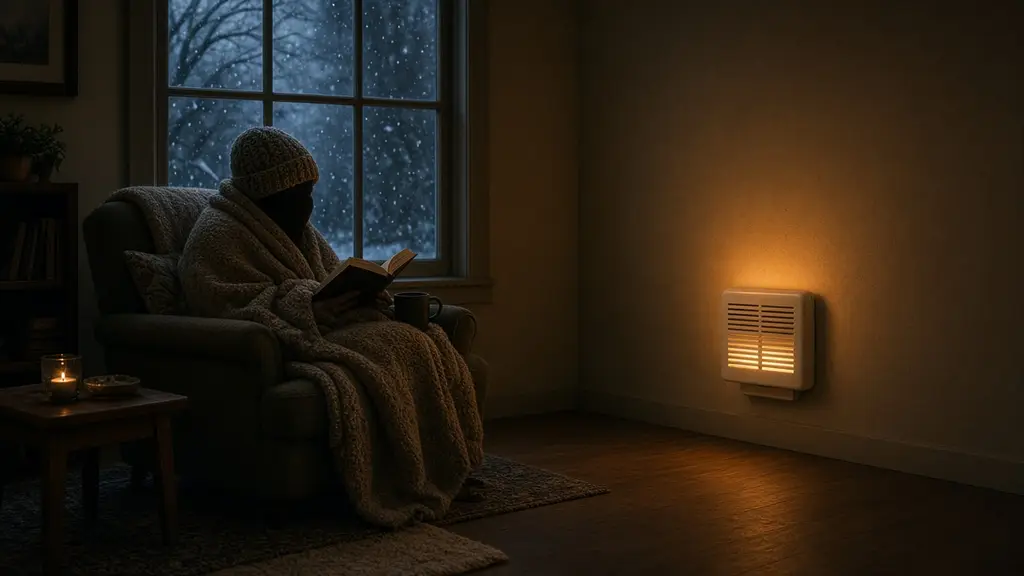
What HeatSpace is (in plain English)
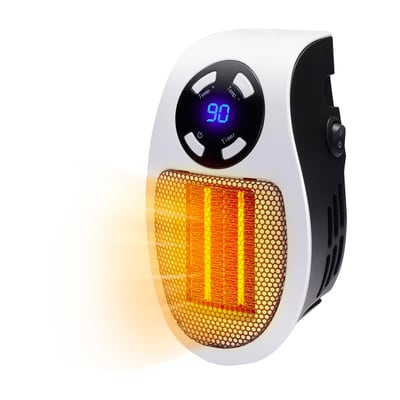
HeatSpace (also written “Heat Space”) is a compact ceramic fan heater that plugs straight into a wall outlet — no stand, no cord across the floor. A ceramic element heats up and a small fan pushes warm air toward you. The seller lists these features (seller claims — check the box when it arrives):
- Thermostat with LED display, adjustable from 60°F to 90°F
- Timer to switch it off (or on) after a set number of hours
- 180° rotating plug, so it sits upright in sideways or upside-down outlets
- Overheat protection: per the seller, if the inside passes 122°F it drops to 104°F, and it shuts off if that happens three times in a row
- A small remote, shown in the official product photos
Not to be confused with Heatspace in New Zealand, which sells home heating products there. This review covers the plug-in HeatSpace sold to U.S. buyers through online ads.
Why people buy it
- Warm air in a couple of minutes. Ceramic fan heaters start blowing warm air almost as soon as you switch them on — no waiting for the furnace to reach your corner. (The seller says “under two minutes.”)
- Set it and stop fiddling. A thermostat holds the temperature you pick instead of blasting at full power, and the timer shuts it off on schedule.
- Zero installation. No tools, no mounting, nothing on the floor to trip over or knock down.
- Goes where you go. Bathroom before your shower, desk by nine, reading chair at night — any standard outlet.
- No fumes. It’s electric: no flame, no fuel smell, no carbon monoxide.
- Three months to decide. The official checkout shows a 90-day money-back guarantee — time to try it through a real cold snap (fine print below).
Opens the official seller site · affiliate link
What it really costs to run
Here’s something the ads won’t tell you: HeatSpace’s own sales page gives two different wattages. The feature section says it “uses just 500 W”; the FAQ on the same page says “650W (Low) – 1200W (High).” So we did the math for both, at the U.S. average residential price of 18.17¢/kWh (EIA, September 2026):
| If it draws… | Per hour | 4 h/day for a month | 8 h/day for a month |
|---|---|---|---|
| 500 W | ≈ $0.09 | ≈ $11 | ≈ $22 |
| 650 W (low setting) | ≈ $0.12 | ≈ $14 | ≈ $28 |
| 1,200 W (high setting) | ≈ $0.22 | ≈ $26 | ≈ $52 |
That’s our math (watts ÷ 1,000 × hours × price). The real number for your home depends on your rate and how long it runs — and with a thermostat, it won’t draw full power the whole time once the space is warm.
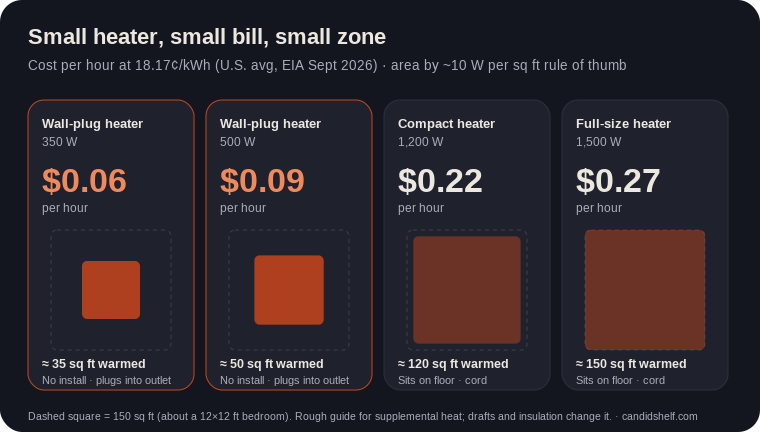
Plug in your own rate and hours (start at 500 W, then try 1,200 W):
Running-cost calculator
What will it cost you?
Electric heaters turn the power they draw into heat. Cost depends only on watts, hours and your rate.
Default rate: U.S. average residential price, 18.17¢/kWh (EIA, Sept 2026). Check your bill for yours.
Per hour
—
Per 30 days
—
Heat output
—
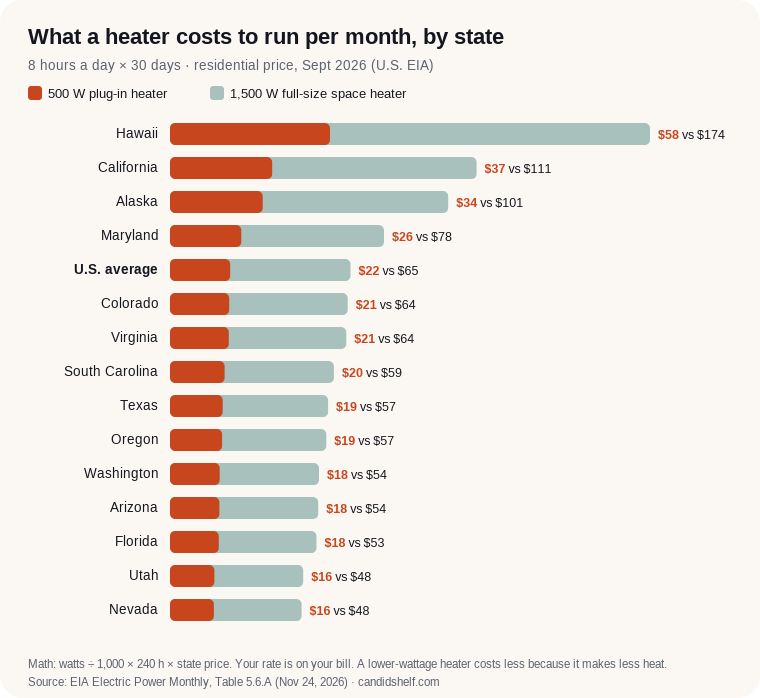
Your state changes everything. The same heater costs over three times as much to run in Hawaii as in Nevada:
HeatSpace vs the alternatives
| Feature | HeatSpace (wall-plug) | Full-size 1,500 W heater | Turn up central heat |
|---|---|---|---|
| Setup | ✓ Plug into outlet Edge | Floor unit + cord | ✓ Nothing |
| Cost per hour | ≈ $0.09–$0.22 Edge | ≈ $0.27 | Whole-house — highest |
| Space it warms | Small bathroom / desk zone | ✓ Small–medium room (~150 sq ft) | ✓ Every room |
| Thermostat + timer | ✓ Yes (seller) | Model-dependent | ✓ Yes |
| Floor space | ✓ None Edge | ✗ Takes floor space | ✓ None |
| Wattage clearly published | ? Two figures on one page | ✓ Usually on the box | — |
| Best for | Warming YOUR spot | Warming a whole small room | Warming the whole house |
The bottom line: if your problem is “this little bathroom is freezing” or “I’m cold right here,” HeatSpace is a cheap-to-run, no-install fix. If your problem is “the whole living room is cold,” a full-size 1,500 W heater with a UL or ETL mark is the right tool.
Opens the official seller site · affiliate link
The fine print, decoded
We read the checkout, returns and contact pages so you don’t have to. What we found on 26 November 2026:
- Price: the official checkout showed $49.95 for one unit, against a crossed-out $99.90 we can’t verify. Shipping and tax are added at confirmation.
- The 3-pack is preselected. The checkout opened with the 3-unit package ($134.85) already chosen. If you only need one, switch to 1x before you pay.
- Black Friday code: the sales page advertises code BF26 (50% off one, 60% off three). Judge the final total at checkout, not the percentage.
- Countdown timers and “Stock Levels: LOW”: the sales page shows them, and the checkout says your order is “reserved” for 10 minutes. We can’t verify either. Take the time you need.
- Returns: the checkout promises a 90-day money-back guarantee (refund or replacement, less shipping and handling). The returns page on getheatspace.com adds that you need an RMA number from support first, the item should be in its original packaging, and a 10% restocking fee may apply. A second HeatSpace site (buyheatspace.com) shows a 30-day window, so read the terms on the page where you actually pay.
- Support: 1-888-824-1094 (7 a.m.–5 p.m. Pacific) and cs@topportableheater.com, per getheatspace.com. The contact page and the returns page list different California addresses — another reason to get your RMA and return address from support in writing.
Your doubts, answered
“Is HeatSpace a scam?”
We found no sign it’s a no-delivery scam: there’s a working checkout, a published price, a U.S. phone line and a 90-day guarantee. What deserves caution is the marketing. MalwareTips called the “Heat Space” ads misleading back in 2023 — claims like heating any room in two minutes and cutting bills by 30%, plus fake urgency — and said the same type of heater keeps being renamed. There are also fake Elon Musk endorsement ads using the name (JordanLiles.com). Ignore the hype and judge it as what it is: a small spot heater.
“Is it the same as TopHeat?”
It looks that way. HeatSpace and TopHeat are sold on the same advertiser domain with identical official product photos, and HeatSpace’s support email is a “topportableheater.com” address. The returns policy is the same template used by other heater brands (Heat Wave Pro, Heat Zone, Elite Heat) that name the same company, Production Products, Inc. If you’re comparing the two, compare price, return terms and published wattage — read our TopHeat review for its side.
“Will it actually keep me warm?”
Close to it — yes, that’s the point. Rule of thumb: about 10 W per square foot of supplemental heat, so even at 1,200 W it covers roughly a small bathroom or a desk zone, not an open living room. The buyer feedback we found says the same: handy in small spaces, underwhelming in larger rooms.
“Is it safe?”
The seller lists overheat protection, and electric ceramic heaters burn no fuel, so there’s no carbon monoxide. The seller doesn’t state a UL or ETL listing, so look for the mark on the unit when it arrives. Then follow NFPA and the U.S. Fire Administration: plug it straight into a wall outlet (never a power strip or extension cord), keep 3 feet clear of towels, curtains and bedding, and switch it off when you leave the room or go to sleep. Unplug it if the plug feels hot or you smell burning.
“Is it noisy? Is it well built?”
It has a fan, so expect a hum — some buyers found it noisier than they wanted. And don’t expect premium build: MalwareTips describes heaters sold through these ads as generic, low-cost units. For a bathroom or a desk most people won’t mind the noise; if you need silence for sleep, a fanless option fits better (and nothing should run while you sleep anyway).
“What if it’s not for me?”
That’s where HeatSpace’s 90-day guarantee helps. Make it count: keep the box and packaging, pay by card or PayPal, save your order email, and if it’s not right, contact support for an RMA number before you ship anything back.
Opens the official seller site · affiliate link
Winter is here — get warm before the next cold snap
Cold snaps arrive with little warning, and nearly half of U.S. home heating fires — a good proxy for when people lean on heaters — happen between December and February (NFPA). The seller is running a Black Friday code right now, and it says orders ship by USPS within 48 hours with 2–5 business days for delivery. We can’t confirm shipping times, so if you want it before the next freeze or under the tree, check the delivery estimate at checkout.
Who should skip it
- You need to heat a large or drafty room → get a full-size heater with a stated 1,500 W rating and a UL/ETL mark.
- You want heat while you sleep or while you’re out → no portable heater should run unattended.
- You won’t buy without one clear wattage and a safety listing → ask support to confirm both before you order.
Our verdict
If you’re tired of freezing in one small room and don’t want to pay to heat the whole house, HeatSpace is a simple, no-install way to warm the spot you’re in — with a thermostat, a timer and a 90-day return window to back it up. Pick the single unit, read the return terms, and use it for what it is: a personal heater, not a furnace.
Opens the official seller site · affiliate link
New to plug-in heaters? Start with our guide: are plug-in wall heaters worth it? Safety, cost and who they’re for.
Questions people ask
Does the HeatSpace heater really work?
Yes — for the right job. It’s a small ceramic fan heater that plugs into a wall outlet and blows warm air you feel close to the unit. It’s built to warm a small bathroom, a desk or a reading spot. Expect it to heat a big living room and you’ll be disappointed; that’s the most common complaint.
How many watts is HeatSpace?
The official sales page says two different things: “uses just 500 W” in the features, and “650W (Low) – 1200W (High)” in its own FAQ. A third-party review site lists 445 W. Check the rating label on the unit when it arrives. At the U.S. average electricity price, that’s roughly 9 cents an hour at 500 W and 22 cents at 1,200 W.
Is HeatSpace a scam?
We found no evidence that it’s a no-delivery scam: it’s sold through a working checkout with a published price, a U.S. phone number and a 90-day money-back guarantee. But the ads around the “Heat Space” name have been called misleading by MalwareTips (exaggerated heating and bill-saving claims, fake urgency), and there are fake celebrity-endorsement ads using the name. Buy it as a small spot heater, ignore the hype, and pay by card or PayPal.
Is HeatSpace the same as TopHeat?
They look like the same product under two names. Both are sold on the same advertiser domain with identical official product photos, and HeatSpace’s support email uses a “topportableheater.com” address. We couldn’t confirm who manufactures either one.
Will HeatSpace lower my electric bill by 30%?
Not on its own. The seller claims you can slash your bill by 30%, but every electric resistance heater turns power into heat at about the same efficiency (U.S. Department of Energy). You save only if you warm the room you’re in and turn the main thermostat down — DOE says a 7–10°F setback for 8 hours a day can save up to 10% a year on heating and cooling.
What is HeatSpace’s return policy?
The official checkout shows a 90-day money-back guarantee: send it back in the original packaging for a refund or replacement, less shipping and handling. The returns page on getheatspace.com adds that you need an RMA number from customer service first and that a 10% restocking fee may apply. Another HeatSpace site lists a 30-day window, so check the terms on the page where you actually pay.
Can I leave HeatSpace on overnight?
No. NFPA and the U.S. Fire Administration say to turn portable heaters off when you go to sleep or leave the room. The seller’s own FAQ also says you should never leave any heater on unattended.
Is HeatSpace a good gift?
It’s a practical one for someone who’s always cold at their desk or in a chilly bathroom. The seller says orders ship by USPS within 48 hours with 2–5 business days for delivery; we can’t confirm that, so check the estimate at checkout if you need it by a date.
Sources
- [1]HeatSpace official sales page (offer 4116 landing, checked Nov 26, 2026)
- [2]HeatSpace official checkout (price, packages, 90-day guarantee, checked Nov 26, 2026)
- [3]getheatspace.com — Returns & exchange policy (90 days, RMA, restocking fee)
- [4]buyheatspace.com — Returns & exchange policy (30 days)
- [5]getheatspace.com — Contact page (support email, phone, addresses)
- [6]getheatspace.com — Product page (thermostat range, timer, rotating plug)
- [7]MalwareTips — Heat Space heater ads investigation (Nov 2023)
- [8]JordanLiles.com — Fake Elon Musk endorsement ads for Heat Space
- [9]Scam Analyzer — Heatspace review & customer feedback (noise, larger rooms)
- [10]Comparison.co — Heat Space portable heater review (reported 445 W)
- [11]NFPA — Portable electric space heater safety
- [12]NFPA — U.S. home heating fires peak during winter months (Jan 2026)
- [13]U.S. Fire Administration — Heating fire safety
- [14]U.S. EIA — Electric Power Monthly, Table 5.6.A (residential price by state, Sept 2026)
- [15]U.S. Department of Energy — Programmable thermostats (setback savings)
- [16]U.S. Department of Energy — Electric resistance heating
Hatim Founder & editor
Hatim founded CandidShelf and writes its reviews. He reads the seller pages, the fine print and the complaint records, runs the cost math with U.S. government data, and says plainly when something hasn’t been hands-on tested yet.