Are Plug-In Heaters Worth It? Yes — Used the Smart Way
Cold room, rising bill? A plug-in heater can be a smart buy — when it warms you, not the whole house. The honest math, safety rules and how to pick one.
Official product photos
From the official seller site · tap a photo to enlarge
Quick verdict
30-second readBest for: anyone who’s cold in one spot — desk, bathroom, reading chair — and wants cheap, instant, no-install warmth.
Worth it as a personal warmer that lets you turn the main heat down. Not a whole-house heating replacement.
Affiliate link · we may earn a commission · details
Disclosure: some links on this page are affiliate links. If you buy through them we may earn a commission at no extra cost to you. It never changes the verdict. Details
What this is based on: seller listings, NFPA and U.S. Fire Administration safety guidance, U.S. EIA electricity prices and U.S. Department of Energy information. We haven’t measured a unit ourselves yet; when we do, we’ll add our numbers and say so.
On this page
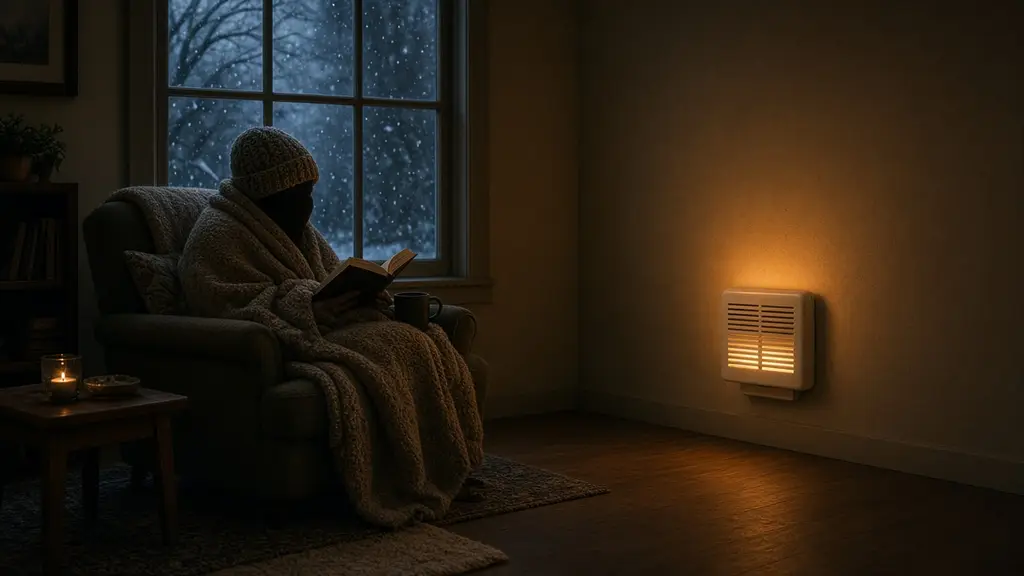
It’s snowing outside. You’re wrapped in a blanket, wearing a hat indoors, and you still can’t feel your toes. You could turn the thermostat up — but then you think about the bill, and you pull the blanket tighter instead.
Then an ad shows up: a tiny heater that plugs straight into the wall and “warms any room in minutes.” Smart buy or gimmick?
Short answer: a plug-in heater is worth it when you use it to warm you, not the whole house. Used that way, it’s one of the cheapest ways to stop being cold. Used as a furnace replacement, it’ll disappoint. Here’s how to get the first result.
The ad says
The reality
“Heats any room in minutes”
It warms the area near it fast. Whole-room heat depends on watts — a 500 W unit covers roughly a desk zone.
“Cuts your energy bill”
The saving comes from you: warm your spot, turn the main thermostat down. That combination is where the money is.
“Safe, leave it on”
Safe when used right — but NFPA says turn any portable heater off when you leave or sleep.
Why plug-in heaters are so popular
- Instant comfort where you are. Ceramic fan heaters start blowing warm air almost as soon as they’re switched on.
- No install, no floor clutter. The heater hangs on the outlet. No tools, no cord across the room.
- Any room, any time. Desk in the morning, bathroom before a shower, a cold corner at night.
- Low running cost. Small heaters draw little power, so each hour costs just cents (see the math below).
- Clean electric heat. No flame, no fuel, no carbon monoxide.
The money math: why “heat yourself, not the house” works
Central heat warms every room to make the one you’re in comfortable. A plug-in heater lets you flip that: keep the house cooler, keep yourself warm. The U.S. Department of Energy says turning your thermostat back 7–10°F for 8 hours a day can save as much as 10% a year on heating and cooling.
One honest caveat: no electric heater is “magic.” Every electric resistance heater turns its power into heat at about the same efficiency (DOE). The savings come from heating less space, not from special technology.
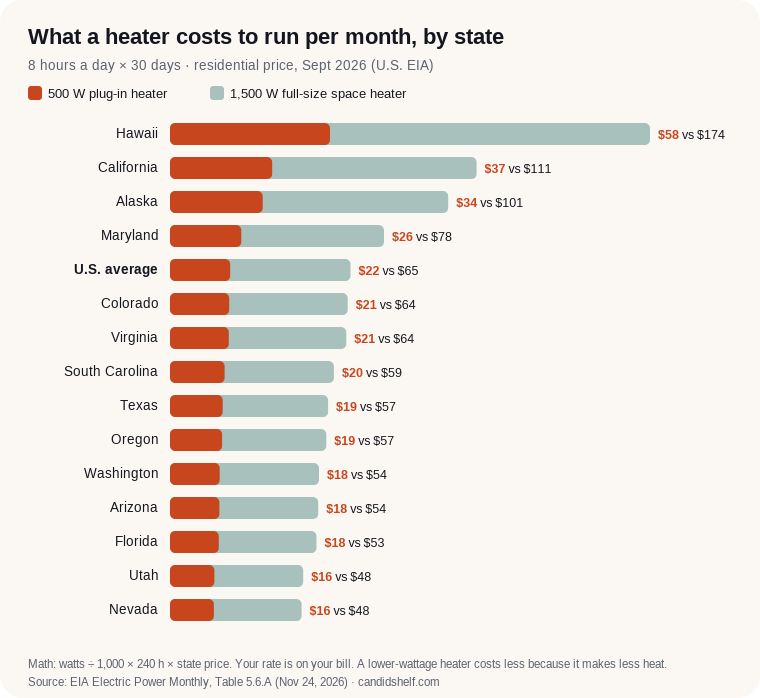
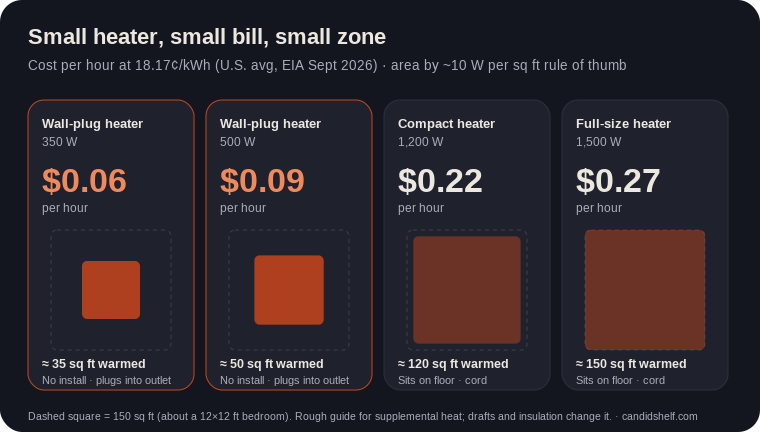
What it costs to run (U.S. average 18.17¢/kWh, EIA Sept 2026)
| Heater power | Heat output (≈ BTU/h) | Cost per hour | 8 h/day for 30 days |
|---|---|---|---|
| 350 W | ≈ 1,200 | ≈ $0.06 | ≈ $15 |
| 500 W | ≈ 1,700 | ≈ $0.09 | ≈ $22 |
| 1,200 W | ≈ 4,100 | ≈ $0.22 | ≈ $52 |
| 1,500 W (full-size space heater) | ≈ 5,100 | ≈ $0.27 | ≈ $65 |
Math: watts ÷ 1,000 × hours × price per kWh. 1 watt ≈ 3.412 BTU/h.
Running-cost calculator
What will it cost you?
Electric heaters turn the power they draw into heat. Cost depends only on watts, hours and your rate.
Default rate: U.S. average residential price, 18.17¢/kWh (EIA, Sept 2026). Check your bill for yours.
Per hour
—
Per 30 days
—
Heat output
—
Opens the official seller site · affiliate link
How much space will it warm?
A common rule of thumb for supplemental electric heat is about 10 watts per square foot:
- 350–500 W → about 35–50 sq ft (a desk zone, a small bathroom)
- 1,200 W → about 120 sq ft (a small 10×12 ft room with decent insulation)
Plug-in heater vs the alternatives
| Feature | Plug-in wall heater | Full-size 1,500 W heater | Turn up central heat |
|---|---|---|---|
| Setup | ✓ Plug into outlet Edge | Floor unit + cord | ✓ Nothing |
| Cost per hour | ≈ $0.06–$0.09 (350–500 W) Edge | ≈ $0.27 | Whole-house — highest |
| Space it warms | Desk / small bathroom | ✓ Small–medium room | ✓ Every room |
| Floor space | ✓ None Edge | ✗ Takes floor space | ✓ None |
| Portable | ✓ Any outlet | ✓ Carry it | ✗ No |
| Best for | Warming you, cheaply | Warming a small room | Warming the whole house |
Are plug-in heaters safe?
Yes — when the unit is certified and you follow the same rules fire-safety agencies give for every portable heater. Take them seriously: NFPA reports that space heaters and heating stoves account for 47% of U.S. home heating-equipment fires but 73% of the deaths (2020–2024), and nearly half of heating fires happen December–February.
The rules (NFPA & U.S. Fire Administration)
- Look for a testing-lab mark (UL, ETL/Intertek or CSA) on the device itself.
- Keep 3 feet (1 m) clear of anything that can burn — curtains, bedding, clothes, furniture, people.
- Plug it directly into a wall outlet. Never an extension cord or power strip.
- Choose overheat protection and, where it applies, tip-over shutoff.
- Turn it off when you leave the room or go to sleep.
- One heat-producing appliance per outlet.
- Keep it away from water unless the outlet is GFCI-protected (bathrooms).
One extra check for wall-plug models: the outlet carries the heater’s weight. Use a snug, modern outlet, and stop using it if the plug or wall plate gets hot, you smell burning, the breaker trips, or the unit wobbles.
Carbon monoxide? None. Electric heaters don’t burn fuel.
How to pick a good one (60-second checklist)
- Wattage clearly stated — it decides heat and cost
- UL / ETL / CSA mark on the product
- Overheat protection and a thermostat
- Return window — days, who pays return shipping, any restocking fee
- Independent reviews outside the seller’s site
- Final checkout price — judge the total, not a crossed-out “list” price
The plug-in heaters we cover
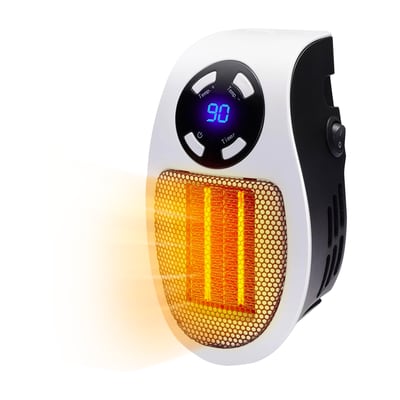
TopHeat is a compact ceramic fan heater sold through its own site. It’s cheap to run (about 6–9 cents an hour at the wattages reported for it), installs in seconds, and fits the “warm the spot you’re in” job well. Its wattage isn’t clearly published, and buyers’ main complaints are close-range heat and fan noise — so buy it for a desk, chair or small bathroom, not a big living room.
-
Read our full TopHeat review: who it’s for, cost by state, complaints & returns HeatSpace looks like the same kind of compact ceramic plug-in, with a thermostat, a timer and a 90-day money-back guarantee on its official checkout. Its own sales page lists two different wattages (500 W and 650–1,200 W), so check the label when it arrives.
-
Read our HeatSpace review: real wattage, cost per hour, returns fine print & complaints
Opens the official seller site · affiliate link
Before winter gets worse
Cold snaps don’t give much warning. If you want a heater in place before the next freeze — or as a holiday gift for someone who’s always cold — order early and check the seller’s delivery estimate at checkout.
Who should skip a plug-in heater
- You need to heat a large room or the whole house → a full-size heater, better insulation or your main system.
- You want heat overnight or while you’re out → no portable heater should run unattended.
- Your outlets are old or loose → fix those first.
Opens the official seller site · affiliate link
Questions people ask
Are plug-in heaters worth the money?
Yes, if you use them to warm the spot you’re in while keeping the rest of the house cooler. They’re cheap to run per hour because they’re low-wattage. They’re not worth it if you expect them to heat a whole house.
Are plug-in heaters safe to leave on overnight?
No. NFPA and the U.S. Fire Administration say to turn portable heaters off when you go to sleep or leave the room. That applies to wall-plug heaters too.
Are plug-in heaters cheaper to run than central heating?
Per hour, a 350–500 W plug-in heater costs about 6–9 cents at the U.S. average price — far less than heating every room. Savings come from turning the main thermostat down while you use it; per unit of heat, electric resistance heat is not more efficient than other systems (U.S. Department of Energy).
Do plug-in heaters save money on electric bills?
The heater itself doesn’t create savings — how you use it does. The DOE says turning your thermostat back 7–10°F for 8 hours a day can save as much as 10% a year on heating and cooling. A personal heater makes that setback comfortable.
Can a plug-in heater heat a whole room?
A 350–500 W model warms a small zone (roughly 35–50 sq ft). A 1,200 W model may warm a small, well-insulated room. Larger rooms need a full-size heater.
Can I plug a wall heater into a power strip?
No. Plug any space heater directly into a wall outlet — never an extension cord or power strip.
Do plug-in heaters give off carbon monoxide?
No. Electric heaters don’t burn fuel, so they don’t produce carbon monoxide.
Sources
- [1]NFPA — Portable electric space heater safety tip sheet
- [2]NFPA — U.S. home heating fires peak during winter months (Jan 2026)
- [3]U.S. Fire Administration — Heating fire safety
- [4]U.S. Fire Administration — Portable heater fire safety flyer
- [5]U.S. EIA — Electric Power Monthly, Table 5.6.A (residential price by state, Sept 2026)
- [6]U.S. Department of Energy — Programmable thermostats (setback savings)
- [7]U.S. Department of Energy — Electric resistance heating
Hatim Founder & editor
Hatim founded CandidShelf and writes its reviews. He reads the seller pages, the fine print and the complaint records, runs the cost math with U.S. government data, and says plainly when something hasn’t been hands-on tested yet.